
Destressing Continuous Welded Rail: Managing Forces You Can’t See
July 30, 2026
Part 2of 3: Managing Rail Stress in Continuous Welded Rail Series
This three-part series explores the fundamentals of Rail Neutral Temperature (RNT), rail destressing, and closure welding, examining why each is critical to the safety and performance of Continuous Welded Rail (CWR).
Rail stress is often invisible, but its consequences are not.
In CWR, thermal forces remain locked into the rail unless they are deliberately addressed. Destressing is the process that restores rail to its desired RNT, ensuring those forces are properly managed rather than unintentionally amplified.
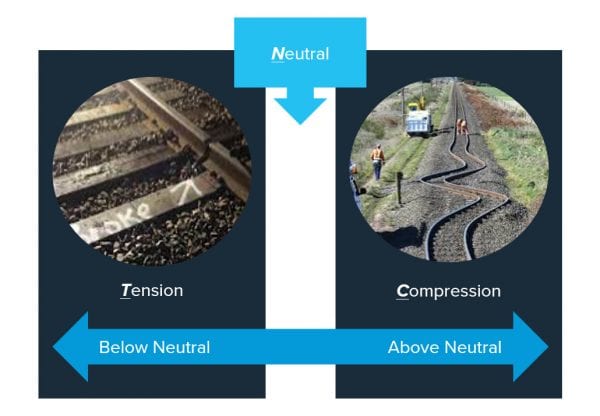
What Happens When Rail Stress Is Mismanaged?
Improper handling of thermal rail forces introduces severe risks:
- Buckling under compression, especially on curves
- Fractures and rail breaks when rail is in tension
- Sudden, catastrophic failures that can lead to derailments, emergency speed restrictions, and costly reactive maintenance
Notably, it takes significantly less force to buckle rail than to break it:
~818 kN of compressive force can cause buckling vs ~1,523 kN of tensile force is required to cause a break
This makes hot-weather stability a constant concern when rail stress is not properly restored.
Common Failure Scenarios in the Field
Rail stress issues are often introduced during:
- Welding and rail replacement activities
- Emergency repairs where stress restoration is overlooked
- Work performed at incorrect rail temperatures
- Use of equipment without sufficient tensioning capability
A common example is closure welding below RNT without compensatory action, such as removing steel and applying a controlled rail pull. This locks future compressive stress into the rail, significantly increasing the likelihood of buckles during hotter conditions and dynamic loading.
The Technology Gap
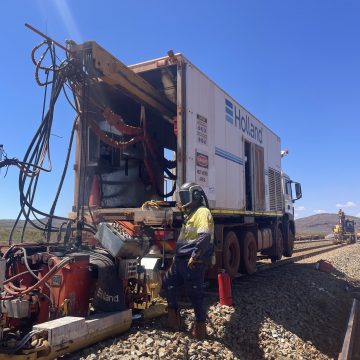
Many rail teams lack reliable systems and equipment to measure and control rail stress. Without access to those, the procedural knowledge to validate that stress has been equalized is often underdeveloped as well. Without stress-aware systems and processes, welds can be compromised from the outset despite seeming to be “in spec”.
Effective destressing requires:
-
- A clear understanding of rail stress mechanics
- Correct procedures to adjust rail to the desired RNT
- Approved, verifiable methods supported by technology
- Automated equipment with repeatability, transparency, and reporting capability
Next in the Series: Part 3 explores why closure welding is more than making a weld. We’ll look at how Intelliweld® and Puller-Lite® combine precise force control, low-consumption welding, and data-driven verification to restore rail stress with confidence.